Wednesday, August 10, 2011

Leslie Knope Would be Proud

Parks & public spaces here in China are exceptional. When we were in Shanghai a few weekends ago the public parks provided a great refuge from the heat of the day and incredible people watching for us tourists. Maybe a little for the locals too, who seemed excited to see us.

People gathered with friends to play board games, walk the dog, cut through the city, practice the saxophone (poorly), or do tai chi.

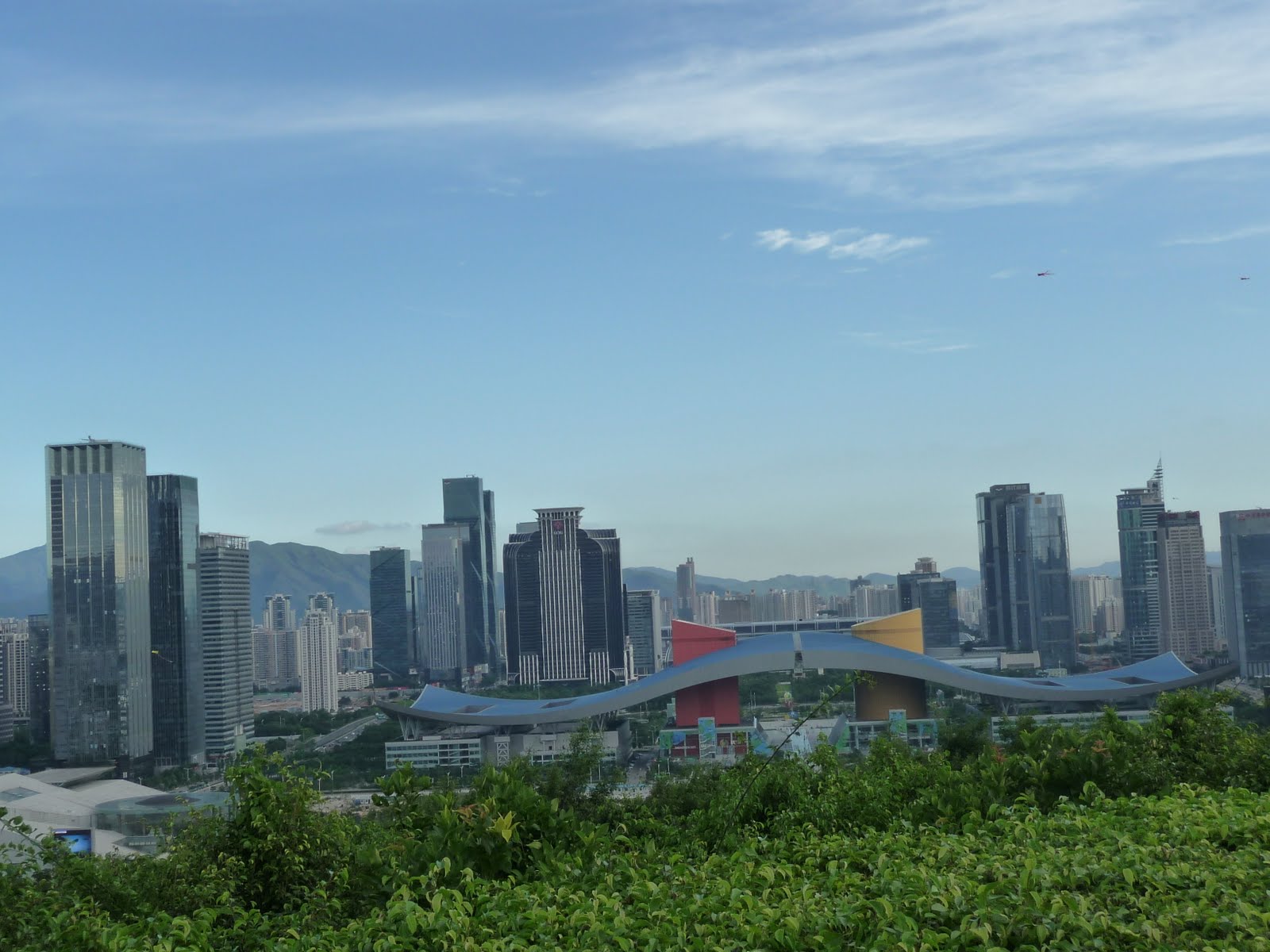
In Shenzhen, the largest central park has incredible views of the city, a great statue of Deng Xiaoping, and kids EVERYWHERE flying kites. It's a pretty, pretty pleasant place to spend a Saturday.

Where most parks in the U.S. lock their gates at sundown, this is when the party really starts in China. The activity here at night is hands down my favorite part about China so far. Badminton, 2 types of jazzercise, ball room dancing, rollerblading lessons, electric animals that light up and play music, and just general cavorting. And of course the guy with the yo-yo contraption that can go 60’ in the air. Ali and I joined in on aerobics one night, bringing back memories of an elementary school jazz recital. Nobody laughed at us except Andy & Alex (apparently we were very much out of rhythm and our long pasty arms made it even worse.)

And it’s not just in the plaza near our hotel. Parks across the city have these gatherings every night where entire families, couples, or just individuals come down to escape monotony of "Must See TV" and spend some time with their friends and neighbors outside.

A few weeks ago, closer to the time of the 90th anniversary of the Communist Party, there were large gatherings of folks playing instruments and singing songs. Here's a little sampling of what Alex and I came across:

Red Songs in the Park by carokate

If there was one thing I could take back and make happen in the US it would be these free, well attended public activities and great public spaces. It seems to be a lovely way to practice a hobby, stay fit, keep in contact with friends, and spend quality time with family. An all-around fantastic accomplishment for small parks dotted around the city.


Tuesday, August 9, 2011

How to Look Cool on a Bike in Shenzhen

Sorry about the delay, folks. The internet has been really picky lately here in the People's Republic, and Work Obligations have really picked up lately.

Excuses, excuses. Where were we? Right. Now that you've rented a bike, what is there to do?

You can put a bunch of stuff on it, of course:


But maybe you should leave that to the styrofoam wranglers of Rubble Street. No, I recommend you head toward the OCT Art Enclave, your typical warehouse-cum-hipsterville full of designer's studios selling found art with birds (or bloody hearts?) on it.


And then pop down to the brand new waterfront greenway! Until the British handed Hong Kong back to China, this area was patrolled by military vehicles to keep people from swimming out of the country. Don't worry, they've got hidden cameras to catch deserters now. This is Jerry, and he helped design it. I think. Regardless, he's cool, even if he does wear a helmet and ride a crazy belt-drive folding bike.


Proper attire is very important:


You'll know you've done it right when others want the moment they were near you to be captured in time and hung upon their mantle!


And try to find this thing, why not.


I have nothing funny to say about this last photo. Enjoy!


Wednesday, August 3, 2011

Low Labor Costs, A Sustainability Hurdle for China?

This post is based on a hunch (a typical leg for an China-intern to stand, whether its hunting out a new restaurant or locating a bike-rental kiosk). All of my assignments thus far have been focused on sustainability planning best practices and I have been asking myself the question-- Is it the relatively low cost of labor in China an added hurdle to sustainable development?

This question is based on two ideas. First, developers in the United States and U.K. have sited profit margins as a check in the pro-column for “going green.” The BedZED (Zero Energy Development) project in Hackbridge, London totes its function mix as revenue earning strategy. I understand it to be a commonplace argument stateside that green developments, even with added upfront costs, can be profitable developments.

Second, A South China Morning Post article from last month “(Built on Ignorance” by Sophie Yu, July, 16th 2011) stated that construction projects in the U.S. typically spend around 55% of project costs on labor. While in China is standard for labor to make up only 30% or less of construction costs. With materials making up a larger portion of total project costs, and given the added cost of green building materials versus standard building materials, “going green” costs relatively more in China. Is it more challenging to develop green projects in China because of the weight materials hold in the feasibility function and the added cost of green construction materials?

There is a hairsplitting amount of construction going on constantly in my neighborhood in Shenzhen. A new subway line opened days before I arrived, a three lane road has been torn-up and repaved a block from my hotel, and brick-layers are building sidewalks literally under my feet. I see construction workers everywhere, often they seem to sleep (and eat and bathe) on-site in temporary housing that ranges from trailers to bamboo scaffolding and tarp. Most construction workers are migrant workers and it is typical that only a few workers on project team will have formal training.

For me this begs the question-Would increasing job quality in the construction industry be a roundabout step toward sustainable development in China? By shifting the pendulum so that labor makes up a higher percentage of project costs (through increased wages and required certifications) and materials make a smaller piece of pie (more similar to the U.S.) would it increase the financial feasibility of sustainable projects in China? UIC Professor Xiangming Chen has noted that China's manufacturing companies reliance on cheap labor to squeeze by profit margins is acting as a barrier to industrial upgrading.

The recent tragic Wenzhou train accident has, maybe for the first time, called into question the rapid pace of development and put slapdash construction practices underneath a media microscope (well as focused as the Chinese-media can get). Further I ask--Would the increased regulation of the construction industry “pump the brakes” of the roaring pace of development?

As per usual in China, I seem to be left with more questions than answers.

Monday, August 1, 2011

Small Victories

True fact: You can rent bikes in Shenzhen for about 25 cents a day. Here's how!
  1. Search the internet for "Shenzhen bike rental." For best results, use the finding-a-plausible-set-of-characters-via-Google-Translate technique.
  2. Have your Chinese roommate (who speaks a little English) call them and see what the deal is.
  3. Upon discovering that it is indeed a real company, head to the business park where you believe their office might be. It doesn't look that big on the map, really. I'm sure you'll find it.
  4. Wander for a bit. Upon finding what is surely a locked-up kiosk full of tiny bikes, call the number your roommate gave you for Mr. Zhao. Give them the name of the building you're sweltering under and say "I'd like to rent a bicycle" in English and unintelligible Chinese. Repeat as necessary. Eventually, they might transfer your call to someone who can speak a little of the Queen's Tongue. Do your best to explain your whereabouts and desires.
  5. Have a McFlurry or something while you wait, hoping someone will come to where you are and rent you a bicycle.
  6. Realize that this is not going to happen and begin looking for other places where a bicycle kiosk might be. There will be several, all in out-of-the-way places, and all closed.
  7. As you realize that this Hi-Tech Park is far too large to be searched thoroughly on foot and prepare to give up this snark hunt, you will receive a text message with an address that you can show to the delivery guys, auto mechanics, and wealthy businessmen you see. Become encouraged when they all point in more or less the same direction.
  8. Praise the Gods, old and new! Off in the hazy distance there's a little shack with bicycles out front! Watch elation turn to dread as you realize the man staffing the kiosk speaks no English, and his forms are entirely in Chinese characters.
  9. Take a slow breath. You are so close. But this is a rather more complex transaction than ordering barbecue with grunts and finger-pointing (which you are so good at, by the way). You must now draw upon the bike karma you've earned in Portland and your local guanxi and get someone who speaks Chinese to interpret your desires to this man. Watch your phone's battery level drop precariously low as you telephone everyone who has ever offered to help you out with translation in China.
  10. Success! Ali's incredible friend Nick and his incredible Girlfriend are on the line to help you! Make sure you understand what is happening. 200RMB for a deposit. Fair enough. One hour for 3RMB and one day for 15RMB? That's a steal! One month for 30RMB? Are you serious? Is anyone even making money here? Who do these guys rent to, anyway? And why is this service only offered in the Hi-Tech Park?
  11. Stop asking questions! Just give the man his money, scrawl what you suspect is the information he wants on his form, and ride off into the sunset! Be sure to thank everyone who helped make this successful transaction possible. And remember, now you owe them one. Such are the rules of guanxi.
For reals, though: www.fqbike.com
There are four locations in the Tian An Cyber Park area. We had success at the Tian Parking Service Point station. It is located on the side of that building that looks exactly like all those other buildings, near that road that smells funny.

Stay tuned for part 2: How to Look Cool on a Bike in Shenzhen

Thursday, July 28, 2011

"Macau, baby, Macau"

Caroline and I went to Macau almost a month ago, so this post is way overdue. Macau is a weird place; a Chinese special administrative region (SAR), Portuguese-influenced, island city-state. It has its own currency, the Macanese Pataca or MOP, and was both the first and last European colony in Asia (handed over to the PRC in 1999). It's also considered the Las Vegas of the east and has actually been the top-grossing gambling market in the world for quite a while, out-pacing Vegas by a staggering 20 billion USD each year.


In stark contrast to this swinging vegas-style hedonism, Macau has also preserved over 400 years of Portuguese influence in its compact old town.


This section of Macau is full of amazing baroque architecture, churches, European squares, and free samples!    From left to right, almond cookies (basically compacted almond powder, good but make sure you drink something with it), egg tarts, and funny-tasting sheets of meat-product.


Macau's southern island, Taipa, is easily accessible via the ubiquitous casino buses that park in front of all large gambling establishments.  So numerous are these buses (every casino has a fleet) and so extensive is their network of stops (every casino in Macau) that they easily beat Macau's actual public transit system (and they're free!).


Taipa is home to most of Macau's ritzy new casino development which includes the Dream City casino complex and the Macau Venetian which is apparently the largest casino in the world.  It looks exactly like it's Las Vegas counterpart and even has "real" Venetian gondoliers.  There isn't much to see on Taipa aside from the casinos as its only other attractions are a dog track and loads of new luxury condos.


Macau is full of strange contradictions.  Old and new, mega casinos and colonial architecture, east and west. It's a playground for the Hong Kong elite, and a reminder of how much money passes through Southern China only to be gambled away in a game of high-stakes mahjong at an Italian-themed casino.  At least you can still find a free dance show on the street and even a friendly panda or two.

Tuesday, July 26, 2011

Intern Tip #57

Combat the monotony of research!

As an intern at CAUPD you will be asked to research many things.  Sometimes you come across topics that are...well...pretty dry. If your goal is to churn out as much work product as quickly as possible, I don't recommend spending approximately 45 minutes on something like this:


Your boss will likely be too busy to notice clever graphics, and there is a good chance that google translator will provide you with an offensive translation.  However, if you have the time, it's nice to have fun with reports you produce.  Plus, you can always put them up on your fridge when you get home...

Thursday, July 21, 2011

Bike+Ped Planning in the Provincial Village of Portland, Oregon.

Caroline and I gave a big presentation about bicycle and pedestrian planning today.  Promotional posters were distributed, e-mails were sent, and most of CAUPD Shenzhen was there.  It went really well and there was a lot of great discussion.  We showed a short video about Portland!  Also, Jolly Ranchers candy was distributed.


We got to present in the main conference room/salsa studio on the top floor of our building. They even gave us microphones just like the ones they use in NBA post-game interviews.


We talked, among other things, about the Mt. Hood Freeway, bioswales, bicycle boulevards, 20-minute neighborhoods, and complete streets.  We conducted spot surveys on mode choice (only one SOV commuter, impressive!), and tried to figure out who in our audience was a "strong and fearless" bike rider and who was more of the "interested but concerned" type.


Comparisons were made between Shenzhen's bicycle and pedestrian infrastructure and our own. There are a lot of great cycle tracks, but sometimes sidewalks double as parking spaces. Maybe they take the term multi-use path more literally than we do?

Green Building, Good Meeting.

Last week I was invited to attend an UPDIS project meeting at the Shenzhen Institute of Building Research (IBR) headquarters in the Futian District of the city. The building not only houses the sustainable architecture and engineering firm, but they built the showcase piece themselves.

After the meeting our team was given a guided tour of the site. IBR is about 20 stories with a 12 story outdoor atrium on the upper floors. The cut-away design of the courtyard allows natural daylight to penetrate deep into the interior of the building. An employee shared with me that the bi-level office suites create an interactive workplace that make collaboration easy. The upper-story outdoor decks, small playground and rooftop gardens all offer beautiful views of the surrounding lush hills and are kept cool by natural breezes.

Other sustainable design features of IBR include:
− Natural ventilation system, featuring adjustable windows
− Personalized ventilation distribution, under seats in auditorium, through tubes at each desk
− Solar photovoltaic panels
− Rain water collection, grey-water recycling and zero discharge of waste water
− Day lighting in underground parking garages through skylights
− Locally sourced building materials
− A program to encourage employees to take the stairs that involved dropping multi-colored pebbles into buckets and monthly prizes (an employee told me the popularity waned after the first year)
− And I am sure many more that were literally lost in translation

My only concern about the true “greenness” of IBR is the site selection of the building. Its hillside location made for great views of the Shenzhen skyline, but the surrounding land uses are no more than 2-3 stories and looked like functional industrial operations. Maybe this area is targeted for future development and added density? (Which in entirely possible!) But as of right now IBR seems out of place.

Overall it was great to be included in this project meeting and tour, even if the meeting was conducted entirely in Mandarin! Experiencing the dynamics and formalities of two firms working together is always interesting. Some things were the same (technical difficulties with projectors and conference callers) and others different (hot tea and warm snacks refilled throughout) than typical meetings in the States. I was even introduced to a University of Oregon Landscape Architecture student who has the luxury of staying onsite in one of the IBR visiting scholar live-work units during her internship.

Tuesday, July 19, 2011

The Great Wall(s) of China

Contrary to what you may have heard, the Great Wall of China cannot be seen from space - at least not with the naked eye. Nor is it one structure, despite the persistent use of the singular form of “wall” in the title. Since “the wall” is actually a series of non-continuous barriers, the effort to sequester the so-called Foreign Devils never quite worked out for the Chinese - despite building 3,889.5 miles of fortifications. In the thirteenth century, when the Mongols invaded, they simply rode their horses through large gaps in the walls. Whoops.


Exposure to the mythology-shattering truth, however, did not diminish my sense of astonishment upon seeing the wall in person. My visit to a partially-restored, partially-crumbling section of the Great Wall called Jinshanling exceeded all my expectations. The scale and sturdy craftsmanship of the structure was certainly impressive, and the steep mountains to both sides were striking. Mostly, though, I enjoyed running, jumping, and climbing on what was once regarded as a critical piece of war infrastructure as if it were designed to be a playground.


The irrelevance of the wall as a defensive structure is in some ways an apt metaphor for modern China’s open door policy and embrace of global capitalism. Yet from a cultural perspective, the idea of linear barriers is still very much alive. In Beijing, metal fences line the streets, walls surround apartment buildings, and stainless steel railings guide crowds through busy subway stations. Most troubling is the walling off of information.


Trying to access this blog, for example, is very difficult in China. Much like the Mongols, you must ride through the gaps in the Great (Fire)wall. Instead of a horse, the appropriate technology for breaching this barrier is a Virtual Private Network (VPN), a service that tricks the Chinese internet police into thinking that you’re accessing Blogger from the United States (Blogger, like many popular websites with user-produced content, is banned in China). While all the Chinese people I've talked to about internet censorship are fully aware of the practice and find it a bit annoying, none of them felt that the way the government controlled the flow of information was a serious issue. It's very difficult for me to understand this point of view. For all the flaws in our system, it really is nice to know that freedom of speech is valued and for the most part protected in the United States. Cue "And I'm proud to be an American / Where at least I know I'm free . . ."

Friday, July 15, 2011

Potpourri

A Couple Interesting Things About Shenzhen, in no particular order:

Physical barriers are needed to keep Shenzhen's millions of residents in line. Bollards stand at many sidewalk entrances and sometimes at the bottom of stairwells, and big metal fences run down the median of major roads. That's not to say that I don't see a hundred people biking the wrong way down the busy streets while mothers with small children and groceries climb the median fence of Shennan Road every day.

The toilets here are weird.

Wayfinding is quite easy, thanks to Pinyin (Latin characters) on most official signs and the enormity of some structures nearby. For instance, I know I am approaching home when I am just north of Space Canoe and its peak is about 30 degrees from the horizon. A sextant would be helpful, also.

Parks in China seem to be very controlled spaces, carefully manicured and full of paved paths. But the use of public space here is extraordinary, especially at night. Just last night we saw:
  • Ballroom Dancing
  • Tai Chi
  • A small (25 or so) group of folks singing what I can only assume are traditional songs while someone accompanied on an old Casio keyboard
  • Teenagers making out
  • Seriously good badminton players
  • A large (100 or so) group of folks singing what I can only assume are traditional songs with male/female call and response, led by a conductor, and accompanied by a shirtless man playing an accordion.
  • Many, many other ambling couples
  • Older folks making out
  • Children playing indecipherable counting games (in close proximity to their parents, of course)
  • Roaming packs of joggers
  • A man standing very, very still
My imitation Crocs, which I probably paid way too much for, are stylish and comfortable. So is my fold-up cot. Check 'em:

While we are only a mild oddity in our neighborhood, visiting tourist attractions that draw people from other parts of China makes us - much like apes at a zoo - part of a family's Shenzhen Adventure. We were stuck posing with children and teens in front of a statue of Deng Xiaoping for half an hour. We were reimbursed for our time with fruit.

"It takes two to stupid" is perhaps my favorite Chinese T-shirt so far. But, while I can comfortably wear medium shirts from an American Walmart, I am sized 2XL in China. I have yet to find pants that fit me, regardless of the number of X's on the tag.

Everything is under construction in preparation for the Universad, and a lot of construction happens overnight while it is somewhat less excruciatingly hot. I expect to wake up one day soon and find Rubble Camp (and its associated worker shanties) transformed into Prosperous Glistening Road. Every planner we've spoken to has expressed disdain for the extensive low-quality face-lift the city is undergoing, stating openly that it is a waste of money and the superficial improvements will look ratty again in a year's time.